Comeback after leukemia
Sport after leukemia: my comeback after a bone marrow transplant
I’m a Czech decathlete. In November 2024, at twenty, I was diagnosed with acute lymphoblastic leukemia, and on March 20, 2025, I had a bone marrow transplant. On August 30, 2026, 528 days later, I ran 100 meters in 11.72 seconds in my first race back. This is how I got there: what I did, what went wrong and what I learned.
This is my story, not medical advice. Every case after leukemia and a transplant is different. Your hematologist decides what is safe for you.
My timeline: from diagnosis to my first race back
- November 2024: diagnosed with acute lymphoblastic leukemia, chemotherapy at ÚHKT in Prague. I lost 12 kg in my first 57 days in the hospital.
- March 20, 2025: bone marrow transplant from a donor in Poland.
- June 2025: first talks about a comeback with my coach, Jan Koutník.
- July–August 2025: back to everyday movement: walks, stairs, table tennis, physical therapy.
- September 2025: the start of regular training.
- March 2026: one year after the transplant; the training load gradually goes up.
- June 2026: my first session in spikes. The European Transplant Games, my target, are canceled because of a heat wave.
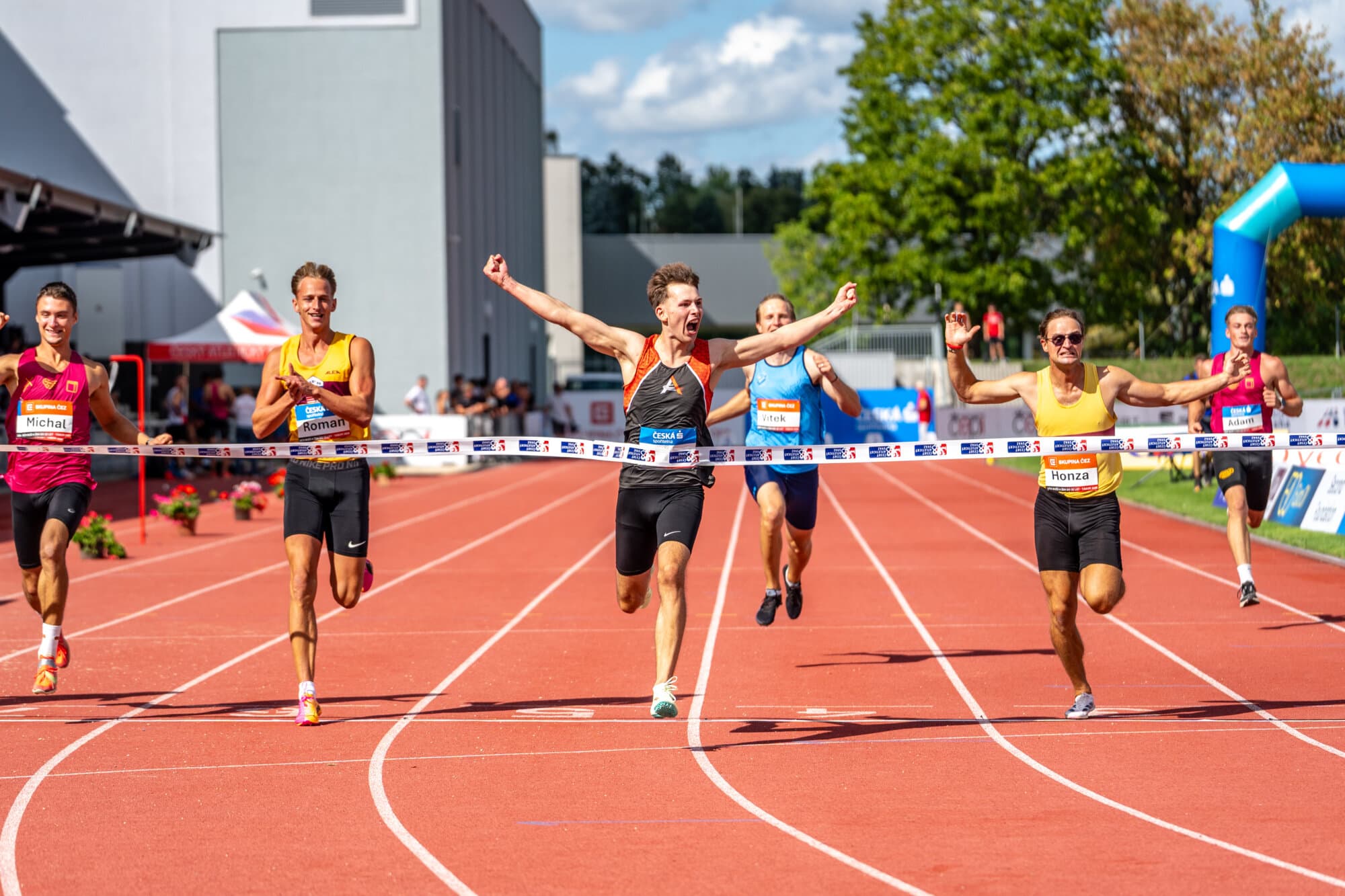
- August 30, 2026: first race back: 100 m in 11.72, an exhibition race at the Czech U22 Championships in Tábor.
When can you exercise after a bone marrow transplant?
That was my first question too. My doctors at ÚHKT gave me a rough framework for a patient without serious complications, and always adjusted to the individual. Rebuilding the immune system takes 2–3 years, and new vaccinations start 7–8 months after the transplant at the earliest.
- 0–3 months: immunity is at its lowest. Mostly walking, physical therapy and breathing exercises.
- 3–6 months: slowly more: walking, swimming, a stationary bike, very light strength work. No sport-specific training.
- 6–12 months: a very gradual return to sport. Mobility, core and basic strength, light running. No contact sports and nothing with a high risk of injury or infection.
- After one year: a gradual return to full load and sport-specific training under expert supervision. Back to your usual training only after about a year and a half.
The first months: learning to move again
In July 2025, I started with the most ordinary things: walks, climbing stairs, standing for longer, table tennis, short bike rides and physical therapy once a week. Even that was hard at first. My energy could change within a single day.
By August, things were clearly heading the right way. On a family trip to the mountains, I did a 16 km hike with a thousand meters of climbing, and my resting heart rate, which had sat around 80 since the start of treatment, dropped back to 50–60. Looking back, the medication was masking a lot of my fatigue. But my body was finally moving again, and my mind loved it.
My training after leukemia: the first six months
From September 2025, I trained under Jan Koutník. The rule was simple: a little, often, and never anything all-out. A typical week looked like this:
- 2 sessions of 45–60 minutes, with as many breaks as I needed
- 2 days of light activity: walks, yoga, table tennis, stretching
- regular physical therapy, which in my condition counted as a full session
- bodyweight strength work, starting at 4–5 exercises × 2–3 sets × 4–6 reps
- sprint drills starting at 3 × 30 m at 50–60 %, with all running kept to 20–80 m
What slowed me down: medication, GVHD and a weak immune system
Corticosteroids made me feel full of energy even when my body was tired, so my coach sometimes ended a session while I felt great. We learned to judge my condition over weeks, not days.
Immunosuppressants meant being careful about infections: I avoided public transportation and crowds, we trained when the gym was empty, and in winter almost only indoors. I had four vaccinations during that time and took at least two days off after each one.
In January 2026, graft-versus-host disease (GVHD) hit my gut, followed by a skin rash that got worse in the sun. On top of that, my calves started hurting in November, most likely because we added sprint drills too early for a body that hadn’t run in almost a year.
Even so, out of 301 tracked days from September 2025 to June 2026, 48 % were active, and health problems kept me from training on only 8 % of days.
One year after the transplant: back to athletics
Around the one-year mark in March 2026, my checkups were good, so we raised the load: 2–3 sessions a week of 60–80 minutes, more strength work and gradually more speed. In April, I made it through a five-day training camp in Olomouc.
By June, I was power cleaning 50 kg, running hurdles again, sprinting 80–90 m at 80–90 % and doing block starts. Then came my first session in spikes since the transplant. A small session for an athlete, a giant one for me.
My first race back
My target was the European Transplant & Dialysis Sports Games in Arnhem, the Netherlands, in June 2026. I even did my last training session on site. Then the Games were canceled because of a heat wave.
So I made my own race at home. On August 30, 2026, I ran an exhibition 100 m race at the Czech U22 Championships at Stadion Míru in Tábor, with my closest friends from athletics. 11.72, first place. Back on the track.
What I’d tell other athletes after leukemia
Every case is different, but this is what helped me:
- Ask your doctors first. Get a clear framework for what’s allowed and when, and ask again at every checkup.
- Find one person to coordinate it all. For me, that was my coach, who kept track of training, physical therapy, medication and everything else going on in my life.
- Start with movement, not training. Walks, stairs and table tennis were my first training plan.
- Keep the structural load low for a long time. Muscles, tendons and bones come back more slowly than your energy does.
- Think in weeks, not days. One good day doesn’t say much, especially on medication.
- Rest is part of the plan. Some weeks you’ll do less than you hoped. That’s normal.
- Have a goal. Mine was to race again. It got me through the worst days.
Read the full case study
My coach, Jan Koutník, wrote up the whole process in detail: the training plans, the numbers, the videos and his view as a coach: Return to Movement and Sport After a Bone Marrow Transplant: The Case of Petr Svoboda ↗
If you’re going through something similar as a patient, a parent or a coach, get in touch.